

The best teaching hospitals in the world run a ritual most professions are too proud for. When a case goes wrong, the doctors close the door and pull it apart together. No defending, no blame. Just the people who do the work, asking out loud what we missed, so none of us miss it again.
They call it the M&M, the Morbidity and Mortality conference, and it is part of why medicine keeps getting safer year after year.
Customer Success has no such room.
We lose an account, feel bad for a Friday, and quietly carry the lesson alone, if we even learned the right one. The renewal that slipped, the exec who went cold, the expansion that stalled at the worst possible time. We replay them in our own heads, with our own blind spots, and then go make the same call again next quarter at full speed.
Let me be honest with you: reading about a case is not the same as sitting in the room where it gets opened up. Not this newsletter, not any of them. The lesson that actually changes how you work comes from people who were there, looking at your situation with you, while there is still time to do something about it.
That is the part an article cannot be. So I built it.
And here’s the CS Pulse Community.
What it is
A closed room of 5-6 CS folks working a real scenario/challenge at a time. The Moderator puts a live situation on the table, a renewal sliding, an onboarding that stalled, a champion who has gone quiet, and the room pulls it apart together: what are you missing, who do you call, what do you do in the first 48 hours.
60-90 minutes. No generic slides. No panel of four people giving rehearsed answers. No vendor pitch.
You leave with a play you can run on your own account, worked out with people who have already lost one the way you are about to, and know where it actually went wrong.
“I already have a CS friend I text when things go sideways”
Good. Keep them. But one friend is one opinion and one direction, usually someone at your own company looking at the same partial chart you are.
This is built to be the opposite. Five or six people, matched to the topic and your experience level, each bringing a real case of their own. It is the difference between venting to one person and getting an honest, structured second read from a room that has seen your exact situation play out and knows how it ends.
That is also what separates this from the big CS communities, where you are one of a thousand quiet members half-watching a webinar you will not remember by Friday. In this room there is no audience. Everyone is in it.
What joining actually involves
The front door is the community itself, and it is free.
A short form, about four minutes. No mandatory calls, no attendance quota, no pressure to perform. Once you are in, you get the recaps and prep from every session, even the ones you do not attend, and you are first in line to apply for the rooms that fit your work.
It is built for people doing the work, ICs through VPs and founders running their own CS, with a few years in and a real point of view. Not “AI expert” badges. Not follower counts.
Why me
I am not the most decorated CSM you will ever meet, and that is sort of the point. This is not built around one guru on a stage. It is built around a room of practitioners who are sharper together than any of us are alone.
What I do know is communities. I have spent eight years living in them and building them, including one of the biggest professional communities, Toastmasters International. I’ve served the community in and out and held multiple positions on multiple levels. I have learned what makes a room actually work versus just exist. Most just exist. This one is built not to.
The first room
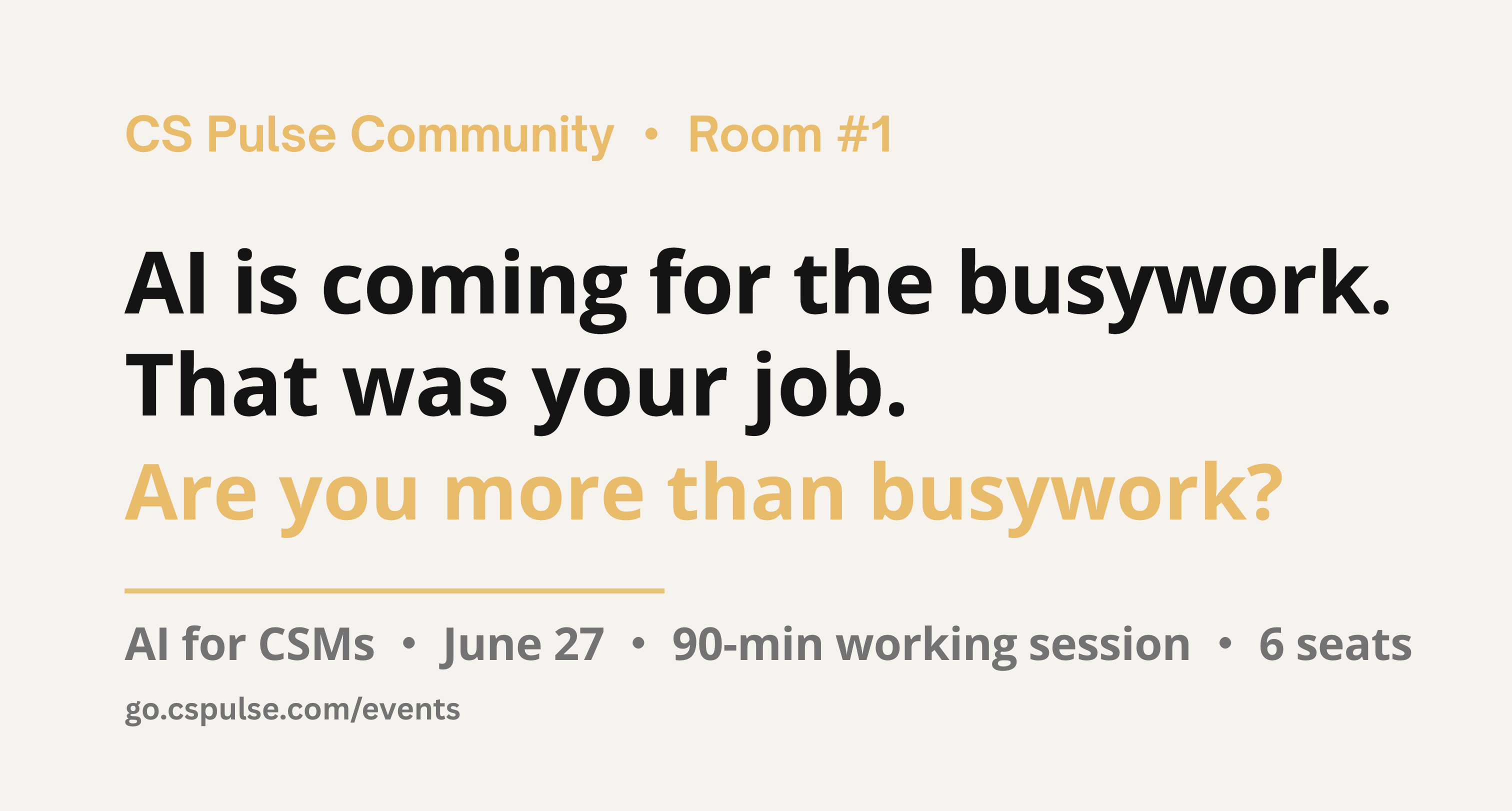
June 27, 2026: AI for CSMs. Not the hype. Where AI is genuinely saving you time, where it is quietly making your accounts worse, and the shortcuts that backfire. More rooms are lined up behind it, each built around one real scenario.
Two ways in
Join the community. Free, about four minutes, and your first access to every room as it opens: go.cspulse.com/community
See the lineup and grab a seat. Starting with AI for CSMs on June 27. Rooms cap at six, so the early ones fill quick: go.cspulse.com/events
⚡ Pulse Point:
Medicine keeps getting safer because doctors dissect their hardest cases together, behind a closed door. CS makes the same mistakes alone, on repeat. The difference is the room.
💬 Reader Prompt:
What’s the lost account you never really got to autopsy with someone who’d actually been there? Reply and tell me. It might be the next scenario we work.
Looking forward to seeing you in the first room.