

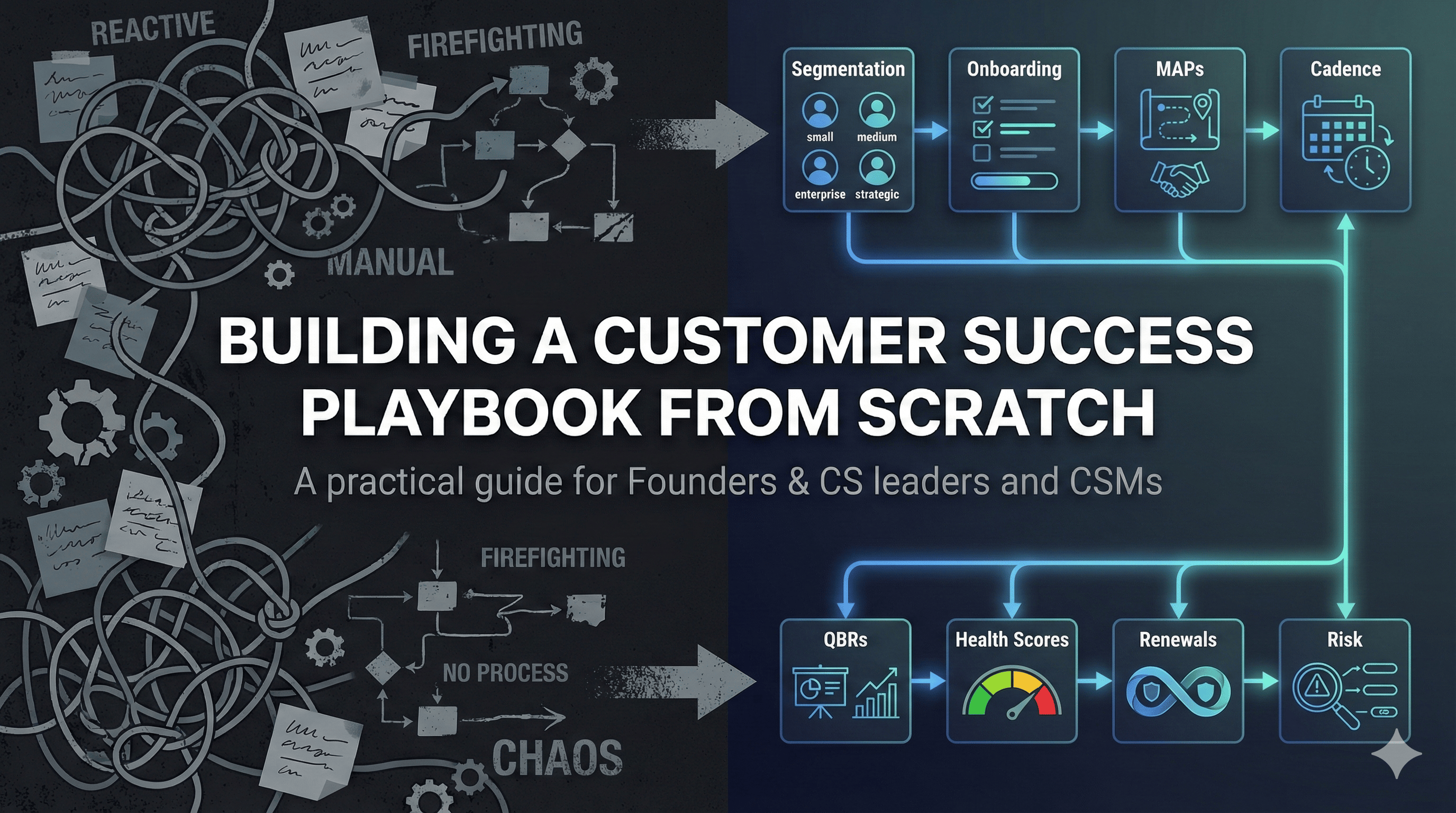
If you’ve ever been asked to “build a Customer Success playbook,” you probably did what every CSM, leader, or founder does:
You opened a blank Google Doc.
Stared at it.
Considered changing careers.
Because here’s the truth we don’t say out loud:
Most CS playbooks weren’t built - they were inherited.
Then quietly fixed for the next 12 months.
And the biggest lie in CS?
You don’t build a playbook. You build a system of decisions.
The playbook is just where those decisions stop living in your head and start living on paper.
Let’s dive into how to build a foundational CS playbook from scratch - one that works whether you’re a scrappy early-stage startup, a growing CS org, or a scaling machine pretending Notion links count as documentation.
🚦 A Mini Case Story: The Tale of “SignalFlow”
Meet SignalFlow, a fictional company that is real enough to hurt:
Early stage: $1.2M ARR, onboarding chaos, founders running half the calls, no one agrees on what “active” means.
Growth stage: $12M ARR, a CS team of 6, everyone uses their own decks, customers have five different experiences depending on who owns them.
Scale stage: $32M ARR, everything “exists” in Notion, but the team treats the playbook like museum art - nice to look at, rarely touched.
Their turning point came when churn punched them in the roadmap.
The CEO said the dreaded words:
“We need consistency. Can someone build a playbook?”
And this - the framework below - is what actually saved them.
🏗️ The Foundation: What Every CS Playbook Must Include
Whether you’re early, growing, or scaling, these components form the backbone. The level of detail changes by stage - not the components themselves.
1️⃣ Customer Segmentation: Your Entire Playbook Depends on This
Segmentation is your north star. If you skip this step, everything else becomes vibes-based CS.
Examples by stage:
Early: simple segmentation - High Touch vs Low Touch
Growth: ARR + complexity + use case
Scale: fully weighted model + ICP alignment + lifecycle risk factors
Segmentation tells you:
Who gets what level of attention
How often you meet
What resources you deploy
How to prioritize limited CSM time
SignalFlow’s lesson: They had 400 customers… and treated them all the same.
Their CSM burnout rate was higher than their NPS.
2️⃣ Customer Journey by Segment
This is the map your team follows from contract → renewal → expansion.
Each segment should have:
Key lifecycle stages
Owner of each stage
Milestones (activation, adoption, maturity)
Required customer inputs
A strong journey prevents the “we thought you were doing that” problem that kills renewals.
3️⃣ Onboarding Milestones: The First 30–60–90 Days Decide Everything
Onboarding is where trust is created or destroyed.
Your playbook should define:
What “live” and “value achieved” actually mean
Mutual Action Plan template (MAP)
Internal handoff → external kickoff steps
The onboarding health signals (usage, responsiveness, alignment)
Example milestone map:
Day 1–7: Kickoff + technical access
Day 14: First value moment
Day 30: Workflow live
Day 60: Adoption review
Day 90: Success plan + QBR invite
SignalFlow’s issue:
Users were “onboarded” but no one could explain activated vs adopted.
It’s hard to renew a customer who never got value in the first place.
4️⃣ Mutual Action Plans (MAPs): The Unsung Hero
MAPs prevent onboarding from becoming a choose-your-own-adventure novel.
A great MAP includes:
Shared goals
Owner for each task (customer vs CSM)
Real deadlines
Dependencies
The definition of success
When customers see the plan, they move faster.
When they don’t, your CSM becomes a professional reminder-sender.
5️⃣ Communication Cadence: Predictability = Trust
Your playbook must define:
Touch cadence by segment
Channel preference (email, call, Slack, in-app)
What’s included in each touch
When to escalate to leadership
Early-stage companies often over-service.
Growth-stage teams under-service because they’re stretched thin.
Scale-stage teams pretend the automated email counts as a “touch.”
A cadence fixes all three.
6️⃣ QBR / EBR Framework: Make It About Them, Not Slides
Your QBR template should define:
Customer outcomes
Progress to date
Key wins
Risks + mitigation plan
Roadmap alignment
Next quarter priorities
Pro tip:
If your QBR is 22 slides and only three are about the customer, it’s not a QBR.
It’s a hostage situation.
7️⃣ Health Scoring: Directional, Not Diagnostic
Health scores should tell you who needs attention - not who should be sacrificed to the churn gods.
Components that work:
Product usage
Time to value
Champion strength
Support signals
License utilization
Executive alignment
Avoid anything that requires a data scientist to maintain.
8️⃣ Renewal & Expansion Playbooks: Predictability Over Heroics
Define:
Renewal date tracking
120/90/60/30-day workflows
How to surface risk early
Who leads commercial conversations
When to loop in Sales
Expansion indicators (usage thresholds, feature adoption, operational maturity)
If you wait until 30 days out, you’re not doing CS - you’re doing CPR.
9️⃣ Risk Escalation Paths: Clarity Prevents Panic
Your playbook should answer:
What counts as a risk
What triggers escalation
Who needs to know (CS → Leadership → Product → Support)
Expected CSM actions
Communication templates
A good escalation process makes problems solvable.
A bad one makes everything “red” until further notice.
🔟 Role Clarity: CSM vs AM vs Support
If roles aren’t clear, tasks get dropped and customers get confused.
Your playbook should define:
Who owns outcomes
Who owns commercials
Who owns tickets
Who owns onboarding
How teams collaborate internally
SignalFlow discovered half of their churn risks were caused by this single issue.
1️⃣1️⃣ Templates: The Secret to Scale
Give your team plug-and-play assets:
Kickoff deck
Mutual Action Plan
Customer journey docs
Quarterly review template
Renewal email sequence
Escalation template
Post-onboarding adoption review
A template isn’t “restrictive.”
It’s the path to consistency when you onboard new CSMs or scale to dozens.
1️⃣2️⃣ How to Roll Out the Playbook Internally
Even the perfect playbook fails if your team doesn’t adopt it.
Steps:
Present the “why” - show what inconsistency is costing you
Train the team by role
Pilot it with 3–5 customers
Iterate fast
Measure usage
Celebrate wins
Assign ownership for updates
Playbooks die when no one owns them.
1️⃣3️⃣ Tooling Recommendations (Practical, Not Fancy)
At early stage - use what you have. Google Docs + HubSpot is fine.
At growth - consider:
CS platform (Catalyst, Vitally, Gainsight, Totango)
Automation (Zapier)
Collaboration (Notion, Confluence)
At scale - invest in:
Dedicated CS ops
Integrated health scoring
In-app guides and usage analytics
QBR automation and executive dashboards
Tools amplify process. They don’t replace it.
⭐ Bonus Components That Will Make Your Playbook Even Stronger
Voice of Customer (feedback loop to Product)
Internal SLAs (response times, project timelines)
Playbook governance (monthly / quarterly updates)
Customer maturity models (crawl → walk → run)
CSM capacity model (who can handle what load?)
Your future team will thank you.
💡 Pulse Point
A CS playbook isn’t a document - it’s a living system that creates consistency, clarity, and customer outcomes at scale.
💬 For Reader
What’s the most important part of your CS playbook - and why?
⚡ Pulse Drop: The One-Liner Framework
If segmentation tells you who you serve, your playbook tells you how you serve them, and your CS rhythm tells you how often you show up.
Incredible framework here, especially the segmentation-first mindset. That line about playbooks not being built but inherited (and quietly fixed for 12 months) is painfully accurate. Saw this at a prior company where we had different CSMs running thier own versions of onboarding because no one ever formalized the MAP upfront. Health scores became meaningless when everyone used diferent signals. The escalation clarity section is underappreciated too, total game changer when things actually go sideways.