

Picture this:
Last Tuesday, your dashboard told you everything was fine.
Customer health: GREEN
Usage: Up and to the right
CSM Slack message: “Looks solid 👍”
Next Tuesday, that same customer sent the email we all dread:
“We’ve decided to move in a different direction.”
No warning.
No rage.
No escalation.
Just… gone.
Welcome to the most expensive lie in SaaS: the traditional health score.
— — —
The “Green Churn” Problem No One Likes to Admit
Let’s talk about the customer who does everything right.
Logs in daily ✅
Opens support tickets ✅
Attends webinars ✅
Responds to NPS surveys with a polite 8 ✅
Health score? GREEN.
Reality? They’ve already shortlisted your competitors.
Because logging in ≠ getting value.
And deep down, you already know this.
— — —
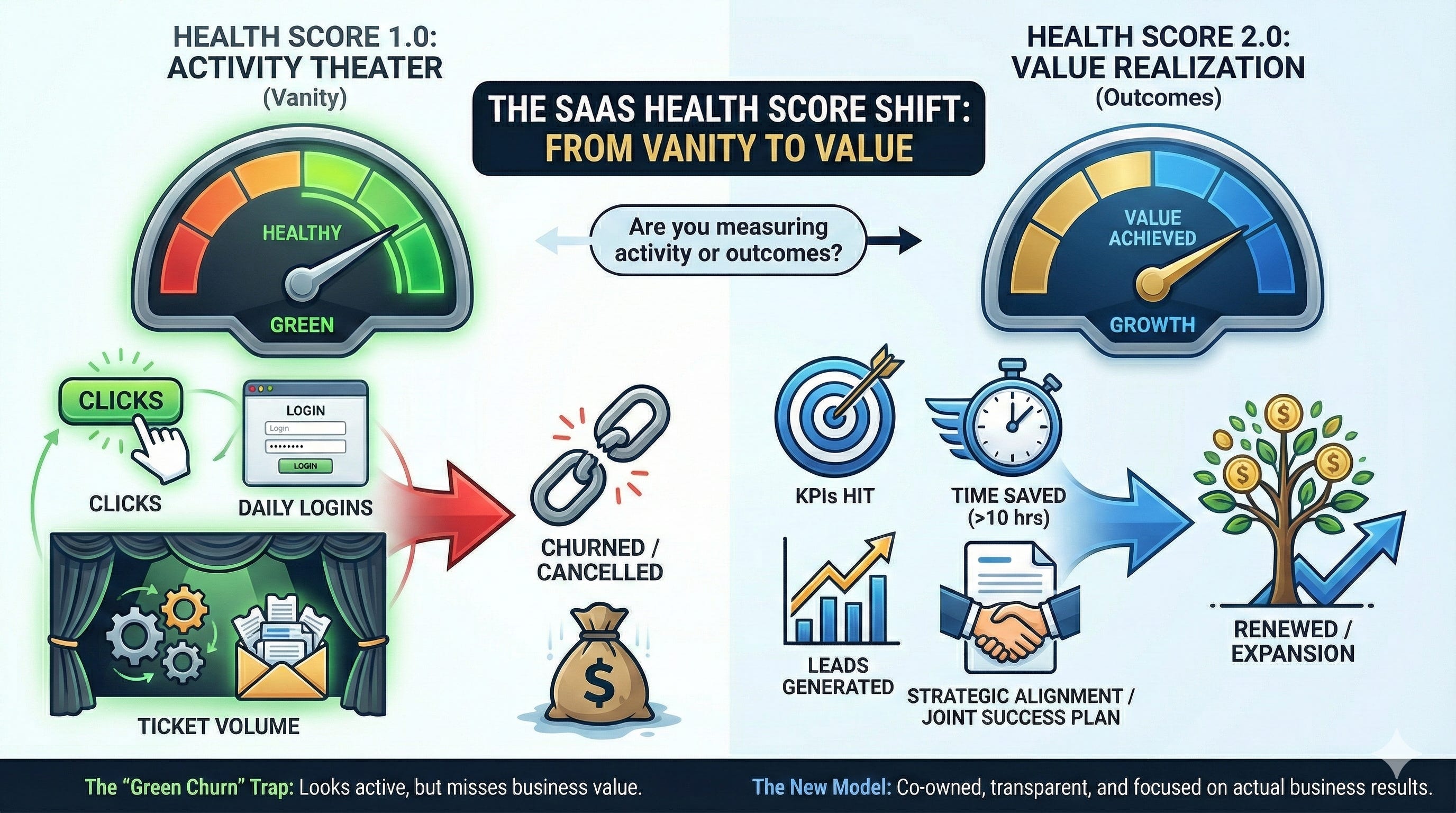
Health Score 1.0: Activity Theater 🎭
Most health scores were built to answer one lazy question:
“Are they using it?”
So we measured:
Logins
Clicks
Feature adoption
Ticket volume
We created beautiful dashboards.
We assigned weights like we were building credit scores.
We felt data-driven.
And we completely missed the only thing that matters:
Is this working for their business?
We counted movement.
We ignored impact.
That’s how you end up surprised by churn that was actually screaming at you for months.
— — —
Why “Green” Customers Churn Quietly
Here’s the uncomfortable truth:
Your customer can be busy and unhappy at the same time.
They log in because:
They’re trying to make it work
They’re extracting the last bit of value
They’re gathering data for a replacement
Usage spikes before churn more often than we like to admit.
Activity is not loyalty.
Activity is not success.
Activity is sometimes desperation.
— — —
Health Score 2.0: Stop Asking the Wrong Questions
Modern CS teams are making a brutal but necessary shift.
Old questions ❌
Did they log in this week?
How many features did they use?
How many tickets did they open?
Better questions ✅
Did they achieve their business outcome?
Are their problems tactical or strategic?
Did our product actually move a KPI they care about?
This isn’t semantics.
This is survival.
— — —
The Anatomy of a Modern Health Score
🎯 1. Value Realization (Primary Driver)
This is no longer “nice to have.”
This is the score.
Not intentions.
Not potential.
Proof.
Examples:
Leads generated > 0
Revenue influenced
Time saved > 10 hours
Costs reduced
SLA met
If you can’t tie usage to an outcome, you’re guessing.
And guessing doesn’t renew.
— — —
⚠️ 2. Commercial Risk Signals (The Stuff Your Product Can’t See)
Some churn has nothing to do with your UX.
Modern health models pull in external reality:
Executive sponsor changed jobs (hello LinkedIn)
Budget freeze announced
M&A activity detected
Company entering “wait and watch” mode
Your product telemetry won’t catch this.
Your CSM should.
Ignoring these signals doesn’t make them go away — it just makes churn feel “sudden.”
— — —
📊 3. Engagement Quality (Not Quantity)
Not all tickets are created equal.
“How do I reset my password?”
→ Transactional. Low signal.“How do I use this to grow revenue in Q3?”
→ Strategic. Very high signal.
Old models punished ticket volume.
New models reward meaningful conversation.
Silence isn’t health.
Smart questions are.
— — —
The Brutal Shift Most Teams Resist
Let’s be explicit.
Old Model
Login frequency = 40% of the score
Fewer tickets = healthier
Outcomes = ignored
Health score = internal secret
New Model
Login frequency = irrelevant
Strategic tickets = healthier
Outcomes = everything
Health score = shared with the customer
Yes. Shared.
— — —
“Wait… You Show the Health Score to the Customer?”
The most mature CS orgs do.
They co-own health scores inside Joint Success Plans.
Because if your health score can’t survive transparency,
it’s not a health score — it’s a comfort blanket.
When customers can see:
The outcomes you’re tracking
The gaps you’re worried about
The risks on the horizon
You stop reporting health
and start managing it — together.
— — —
The Question That Actually Matters
How many of your “Green” customers are actively talking to competitors right now?
How many are busy… but unconvinced?
How many are logging in while mentally checking out?
Because churn doesn’t come from red accounts.
It comes from accounts that look fine - until they don’t.
— — —
If your health score measures activity instead of outcomes, it’s lying to you - politely.
What’s one metric in your health score that feels useful but hasn’t predicted churn even once?