

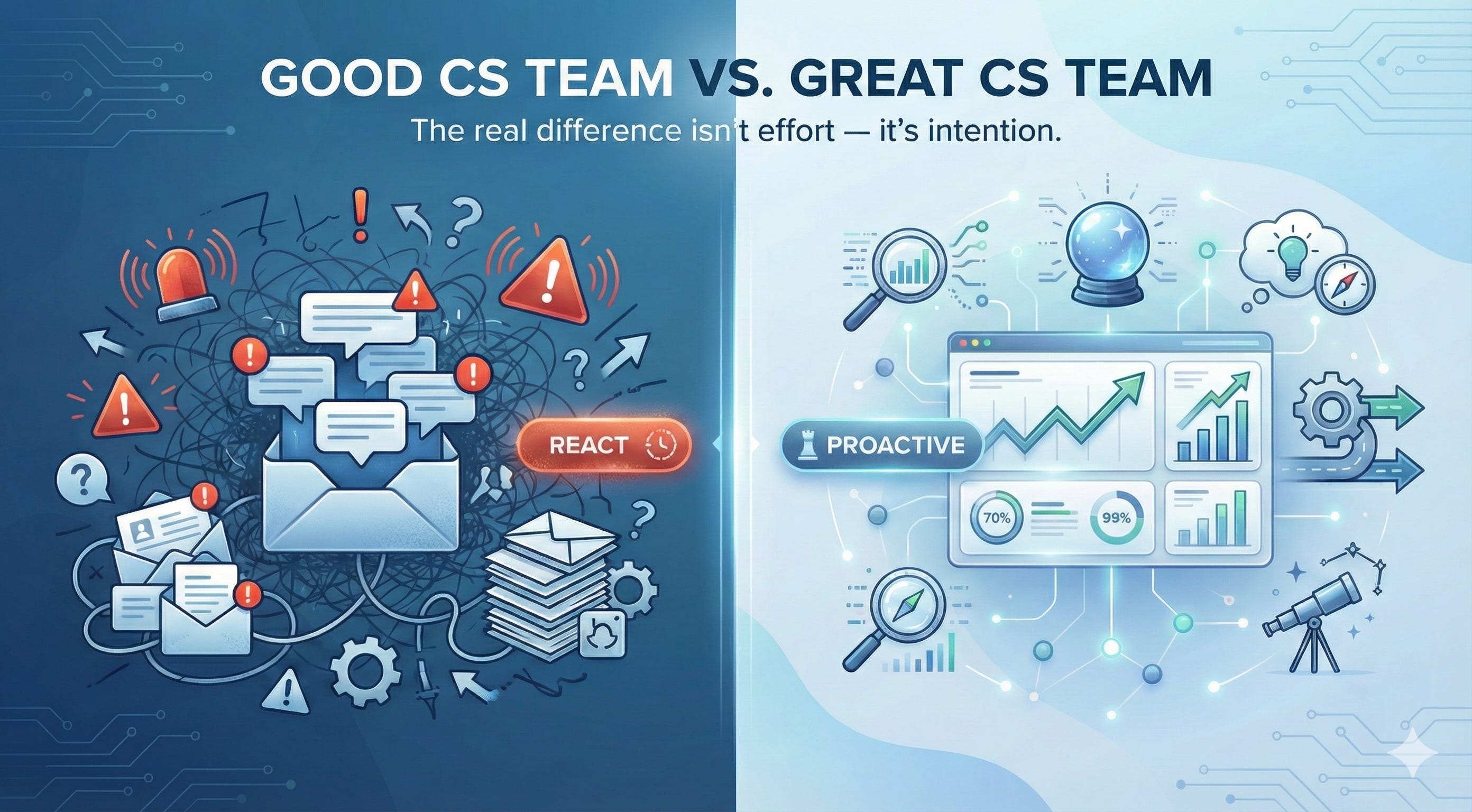
Every CS leader has lived this moment:
You walk into the weekly team meeting.
Slide 1 pops up: “Top 10 Tickets This Week.”
Cue the collective sigh - half defeat, half caffeine withdrawal.
This is the soundtrack of an average CS team.
A team that’s always “almost caught up,” always “heads down,” always living inside Zendesk like it’s an Airbnb with no checkout time.
But then you visit a great CS team.
Different vibe.
No panic. No fire drills. No “Sorry, I missed this - crazy week.”
Instead, it’s:
“We closed the loop on our Q3 expansion hypotheses.”
or
“Here’s the pattern we’re seeing across our top accounts - and what we’re doing about it.”
Same job.
Different universe.
— — —
Insight / Analysis
The gap between an average CS team and a great one isn’t talent.
It’s mindset, mechanics, and math - the small daily decisions that compound into totally different outcomes.
Here’s the real difference:
1. Reactive vs. Proactive
Average team:
Waits for customers to raise issues. Lives in the inbox. Chases problems.
Great team:
Predicts issues before customers feel them. Uses data, signals, and patterns. Prevents problems.
2. Activity vs. Impact
Average team:
Measures “touches,” “calls,” and “tickets closed.”
Great team:
Measures leading indicators of customer health, value realization, and renewal confidence.
3. Firefighting vs. Forecasting
Average team:
Runs from escalation to escalation, assuming chaos is normal.
Great team:
Builds systems, runbooks, and early-warning models to smooth the operational waves.
4. Champion-Dependent vs. Relationship-Multithreaded
Average team:
“One champion → one point of failure.”
Great team:
Exec alignment, end-user feedback loops, and multi-threading that makes the account durable.
5. Feature Training vs. Outcome Ownership
Average team:
Shows customers how buttons work.
Great team:
Shows customers how their business works better because of those buttons.
6. Renewal as an Event vs. Renewal as a Continuous Motion
Average team:
Scrambles 90 days before renewal.
Great team:
Designs the renewal from Day 1 of onboarding. No surprises. No Hail Marys. No “checking sentiment.”
7. Gut Feelings vs. Data-Informed Decisions
Average team:
“We think they’re happy.”
Great team:
“We have six independent signals that show they’re likely to expand.”
8. Lone-Wolf CSMs vs. Cross-Functional Influence
Average team:
CS works hard.
Great team:
CS makes others work smarter - influencing product, sales, marketing, and ops with insights that change the roadmap.
Application / Playbook
If you want to level up your CS org, steal these moves:
✔️ Build a “Value Calendar”
Map out the quarterly, monthly, and weekly actions customers need to actually realize value - and stick to it like muscle memory.
✔️ Replace “Check-ins” with “Hypotheses”
Never show up empty-handed. Bring a theory, a trend, or a predicted blocker.
✔️ Operationalize Early Warning Signals
Usage dips. Champion exits. Support velocity. Expansion intent.
Create a simple dashboard - and review it weekly.
✔️ Document One Process a Week
Great teams aren’t great because they’re heroic.
They’re great because they’re boringly consistent.
✔️ Run Executive Business Reviews, Not Quarterly Therapy Sessions
Focus on ROI, roadmap alignment, and strategic priorities - not “how are things going?”
✔️ Make Renewals a Habit, Not an Emergency
Move every renewal risk upstream by 3–6 months.
Your future self will send you a thank-you latte.
— — —
💡 CS Pulse Point
A great CS team isn’t louder, busier, or nicer - it’s clearer, earlier, and more intentional.
💬 Question For You:
What’s one thing that makes your CS team truly great?
— — —
Pulse Summary:
Great CS teams outperform average ones not by doing more, but by choosing mindsets, systems, and actions that create predictable customer value.